Scroll to explore
Orchestrator or Control Room Managementas a Service
Tuning the brain of your RPA bots
When you are monitoring and managing mission-critical environments, having a dedicated, centralized operations hub is integral to the success of your RPA efforts.
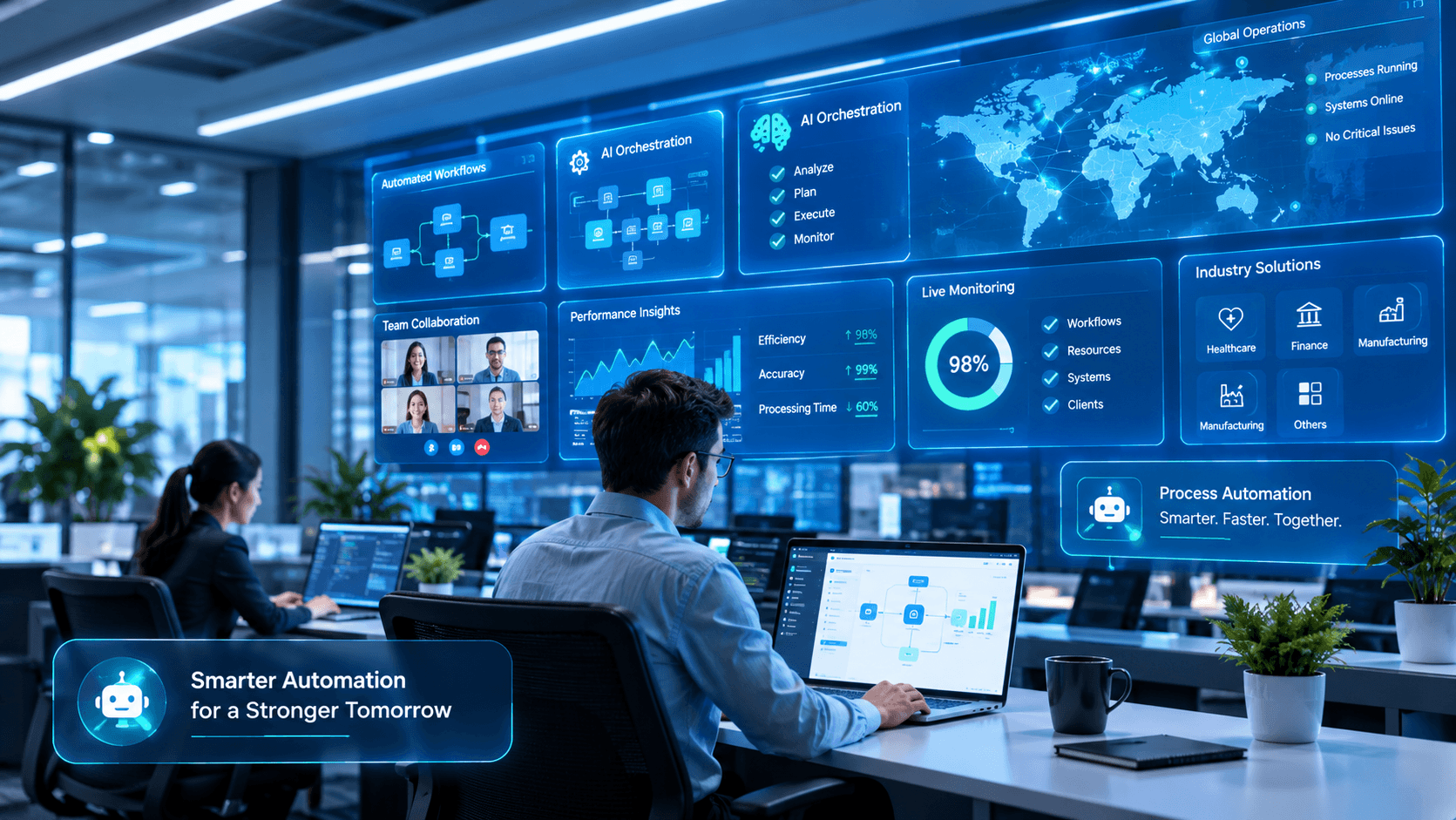
The RPA Control Room functions to provide automated provisioning, orchestration, governance, and actionable analytics for enterprise-wide implementation.
AIRPA's orchestrator functions as the central nervous system for robotic process automation, coordinating all of your bots in a streamlined fashion. While it performs a complex role in managing your diverse automation tasks, the orchestrator has an intuitive interface allowing even non-developers to oversee RPA implementation with ease.
Scale your digital workforce by adding more bots to handle growing workloads — this parallel expansion mimics hiring more staff for increased production.

Orchestrator or Control Room Management as a Service
Know the challenges faced without process orchestration
It's critical to overcome these challenges to improve the degree of automation in your organization — an ideal process orchestration is what you need to make that happen.
Process orchestration coordinates all of the process endpoints, and sometimes even links multiple processes together. Without process orchestration, you have a disconnected set of tasks and automations, which leads to challenges such as:
- Broken workflow automation
- Lack of understanding
- Lack of flexibility

Give your business a unique advantage over your competitors
Book a Demo
Orchestrator or Control Room Management as a Service
AIRPA's Orchestrator — an overview
AIRPA's orchestrator is typically enterprise software used by large companies and managed service providers.
RPA orchestration supports high-level coordination between humans and technology. Without it, automating individual tasks within a process has limited impact. To streamline complex end-to-end processes that involve multiple automation technologies and humans performing many different tasks, organizations need a process orchestration technology.
On top of executing automated bots, the orchestrator's capabilities include:
Storage of predefined process automation scenarios
Timetabled bot deployment across the workflow
Coordination of interdependent bots within the framework
Bridging bots with supplementary third-party tools
Tracking bot status and analyzing detailed activity logs, among other administrative duties
Benefits of our RPA orchestrator
Orchestration works best when businesses need to connect many different systems across complex workflows, but the solution doesn't need to be complicated — AIRPA brings advanced yet easy orchestration to coordinate everything in one place. Even long processes that use many technologies can be simple to manage: AIRPA streamlines cross-functional automation without needing deep technical skills, taming underlying complexity through an intuitive interface.
The interface is very easy to use, even for beginners.
All process management is handled seamlessly from a central dashboard.
The system provides detailed reports that show opportunities to improve workflow efficiency.
The Orchestrator logs all bot and human control actions for air-tight audit compliance and security.
Scheduling unattended bots liberates workers, empowering employees to pursue higher-ROI activities.
Get instantly notified about bot breaks or disruptions.
Accessible via web, mobile, or API integration — compatible with modern and legacy systems.
Orchestrator or Control Room Management as a Service
Why choose AIRPA for RPA Control Room Management as a Service?
Implementing process orchestration can help your team maximize the benefits of automation while also achieving industry-leading levels of efficiency.
AIRPA has deep hands-on knowledge of the entire orchestration process. We understand what it takes to build effective control room solutions, letting us help clients succeed in a concrete way.
- We bridge the gap between what companies hope to achieve and the technology required to get there. Our team translates your strategic visions into detailed orchestration roadmaps ready for real-world implementation.
- With AIRPA as your guide, you can feel confident complex ideas will become simple, actionable automation solutions — our experience means taking plans from paper to production, smoothly and efficiently.
- Focus on orchestrating while achieving even the most ambitious goals around end-to-end process automation, whether in healthcare, finance, manufacturing, or other high-demand industries.