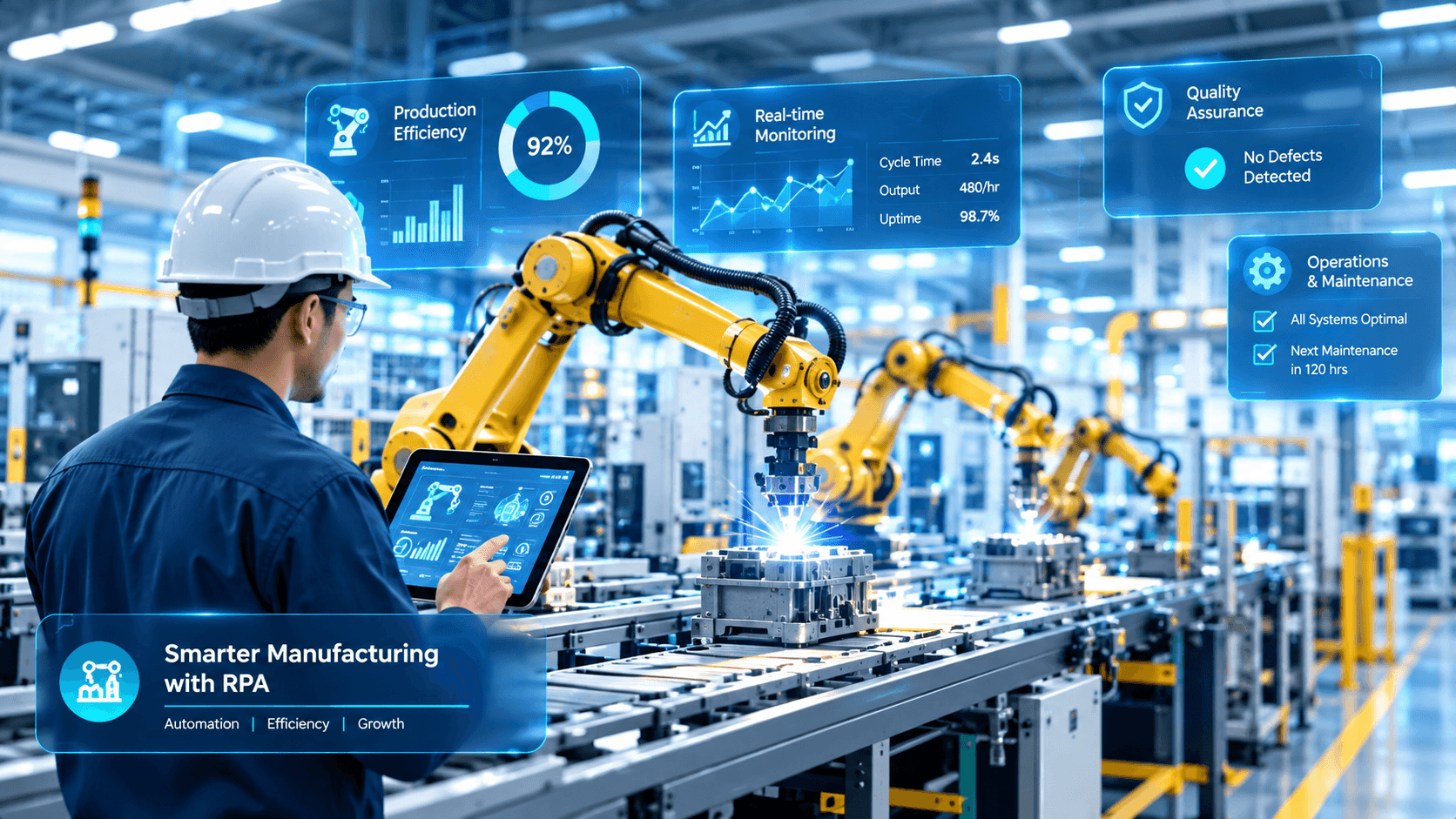
Manufacturers face constant pressure to increase efficiency, reduce costs, and maintain high quality. RPA helps automate repetitive, rule-based tasks, freeing your team to focus on value-driven work.
Automates Repetitive ProcessesHandles high-volume, rule-based tasks with speed and accuracy.
Improves Cycle TimesReduces manual work and accelerates production workflows.
Minimizes Human ErrorsEnsures consistent and reliable operations.
Supports ScalabilityAdapts easily to growing production and business needs.
Automating a task in manufacturing can save 16 hours of human work per week, on an average.Automatingataskinmanufacturingcansave16hoursofhumanworkperweek,onanaverage.
Manufacturing
How AIRPA Maximizes Manufacturing Potential ?
AIRPA utilizes powerful coupling of AI and Robotic process automation (RPA), which are actually indispensable in modern manufacturing, enabling unprecedented efficiencies. Our automation in manufacturing can iron out challenges in handling different processes and help manufacturers in achieving efficiency and productivity in their businesses. So, what are the benefits of deploying RPA in the manufacturing industry?
01
Improved quality control
01 / 12
02
Easy scalability
02 / 12
03
Better compliance
03 / 12
04
Better risk management
04 / 12
05
Reduces downtime, improves quality
05 / 12
06
Streamlined supply chain
06 / 12
07
Global workforce ready
07 / 12
08
Gain greater control over operations
08 / 12
09
Up to 40% reduction in operational cost
09 / 12
10
Enhances the go-to-market speed
10 / 12
11
Reduce costs by reducing human errors
11 / 12
12
Optimized employee performance & satisfaction
12 / 12
Enhance efficiency by automating white-collar processes in the same way they optimize production tasksEnhanceefficiencybyautomatingwhite-collarprocessesinthesamewaytheyoptimizeproductiontasks
Which of AIRPA's Remarkable Manufacturing Use Cases Would You Like to Explore?WhichofAIRPA'sRemarkableManufacturingUseCasesWouldYouLiketoExplore?
Let's see in what functional areas AIRPA can be effectively used.
Bill of Materials (BOM)
Purchase Order Creation
Administration & Reporting
Inventory Management
Help Desk
Data Migration
ERP Automation
Logistics Data Automation
Web Integrated RPA
Regulatory Compliance
01
Bill of Materials (BOM)
For all manufacturers, the bill of materials is an essential document. It is a complete inventory of the raw materials, components, and other objects required to manufacture a certain product.
RPA may help by providing standard templates for developing new BOMs, identifying and alerting for missing documents, and selecting alternate components from databases to guarantee that production runs smoothly.
02
Purchase order creation
Purchase orders (PO) are critical in manufacturing firms, and they require a significant amount of labor and time. When many product categories are present, the complexity grows, making it a difficult process. RPA systems may streamline the entire PO process by adhering to a preset rule-based workflow. This automated procedure entails retrieving important data, getting permissions from various heads via email, and facilitating the seamless execution of PO creation.
03
Administration and reporting
Running a manufacturing firm is far trickier than you imagine. The administration department cannot be expected to solve all process issues. Implementing RPA in the administration department will assist the industry in receiving all production reports and other tasks in their firm, so that they may make an informed decision on how to manage and run their firm.
04
Inventory Management
Using RPA's automation techniques, the associates of inventory may view real-time stock levels of spare parts and materials, receive notifications for placing orders, follow delivery, produce reports, and obtain access to all inventory data. Integrating RPA with supply chain automation allows seamless coordination between inventory levels and logistics, optimizing overall efficiency.
05
Help Desk
Manufacturing sectors must also prioritize customer service in order to keep customers satisfied and happy. RPA systems with a Chatbot function can utilize it to provide a first-level response to client inquiries even when the office is closed.
They can also be programmed to reply to emails in order to cut wait times and compensate for a worker's absence. This allows manufacturers to ensure that their clients are always taken care of.
06
Data Migration
Data migration is the process of shifting data from an old system to a new one. This is a common occurrence in the industrial business. RPA is an excellent alternative for data movement. When a company gets new business, the book of business, which contains its policies, should be kept. Even for a small business, data transfer involves time and money. RPA will undoubtedly lower the duration and expenses with adequate strategy and implementation.
07
ERP Automation
RPA integration with ERP might be the next step in resource planning. Inventory, Accounts Payable and Receivable, Pricing, and other reports are automatically created and may be sent via email or uploaded to a share point folder. A manufacturing firm may check current inventories and alert them when supply is running short. Then you can automate the reordering process.
08
Logistics data automation
Every manufacturing firm needs to have a Logistics department, which oversees the transportation of finished goods to customers. To deliver increased services as quickly as possible, the Transport Management System should be connected with RPA.
You can efficiently monitor product transit by integrating RPA with Transport Management System. This can reduce the number of human errors. When an organization has multiple carriers and insurances, the RPA will provide a report indicating which option provides the best cost, insurance, and transit time.
09
Web Integrated RPA
A well-established corporation may have many branches and offices. It may be more difficult to modify data in a specific system. With RPA in these cases, you can quickly monitor, access, and update any changes in web-connected systems. This decreases communication time from one branch area to another.
10
Regulatory Compliance
In the industrial sector, RPA can guarantee that businesses adhere to all legal and regulatory standards. Employers can better oversee process flows and be ready for external audits as every activity is logged into applications. RPA can guarantee that all legal requirements are met.
Frequently asked questions
Robotic Process Automation (RPA) in manufacturing involves using software robots to automate repetitive, rule-based tasks in production and administrative processes. RPA helps manufacturers streamline operations, improve accuracy, and increase overall efficiency by reducing manual effort in tasks like data entry, inventory management, and supply chain operations.
RPA in manufacturing provides numerous benefits, including improved process efficiency, reduced operational costs, enhanced accuracy in data handling, faster production times, and better resource allocation. It allows manufacturers to focus more on innovation and critical tasks while automating repetitive processes.
RPA in manufacturing works by deploying software bots that mimic human actions to perform tasks such as entering data, updating inventory, and managing purchase orders. These bots can integrate with existing manufacturing systems and ERPs, automating routine processes with minimal human intervention, leading to increased accuracy and faster execution.
Processes like supply chain management, order processing, inventory control, invoice processing, compliance reporting, and customer service can be automated using RPA in manufacturing. This allows companies to enhance their productivity and reduce errors in high-volume, repetitive tasks.
When choosing an RPA solution for manufacturing, consider factors such as ease of integration with existing systems, scalability, flexibility in automating various processes, and support for custom workflows. It's also important to evaluate the RPA provider's track record, customer reviews, and industry-specific expertise.
Airpa offers cutting-edge RPA solutions tailored to the manufacturing industry, helping businesses automate critical processes, enhance productivity, and reduce operational costs. With a deep understanding of manufacturing workflows, Airpa's RPA services are designed to optimize efficiency and streamline operations. Learn more by visiting our website or contacting us directly.
Jumpstart your key manufacturing projects with AIRPA and enhance ROI nowJumpstartyourkeymanufacturingprojectswithAIRPAandenhanceROInow